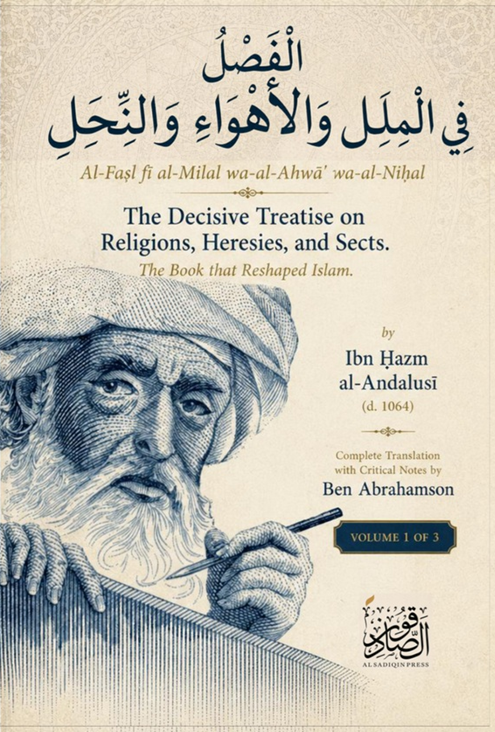
Ibn Ḥazm’s Al-Fiṣal fī al-Milal wa-al-Ahwāʾ wa-al-Niḥal—The Decisive Treatise on Religions, Heresies, and Sects—is not merely a catalogue of religions. It is an attempt to establish a complete hierarchy of truth. Ibn Ḥazm begins with the foundations of knowledge, proceeds through philosophy, Judaism, and Christianity, and then turns his polemical method inward against Muslim theological schools. Throughout the work, he asks the same questions: How can truth be known? Which reports are historically reliable? Which doctrines contradict reason or revelation? Who possesses legitimate authority to interpret Scripture?
His method combines literal reading, logical argument, comparison of textual variants, historical reconstruction, and sometimes relentless ridicule. The result is one of medieval Islam’s most ambitious works of comparative religion, but also one of its most uncompromising. The editors annotations are particularly important because they distinguish Ibn Ḥazm’s genuine insights from inaccurate reports, exaggerated accusations, and occasions when he represents opponents unfairly.
Volume 1 establishes Ibn Ḥazm’s intellectual machinery. He first rejects skepticism and argues that reliable knowledge rests upon sensory perception, self-evident principles, sound reasoning, and authenticated reports. He then addresses the origin of the universe, defending creation against theories of an eternal world, self-creation, multiple creators, celestial governance, and dualist cosmologies.
The discussion advances from natural theology to revelation. Ibn Ḥazm argues that reason can establish the existence and unity of the Creator but cannot independently discover religious law. Humanity therefore requires prophets, whose truth is demonstrated through miracles. He distinguishes miracles from magic, rejects reincarnation, and maintains the finality of Muḥammad’s prophethood.
The volume then introduces two major interreligious confrontations. Against Christianity, Ibn Ḥazm attacks the Trinity, incarnation, divine sonship, and crucifixion theology. Against Judaism, he concentrates initially on the denial of abrogation: if Jews accept that later commandments can replace earlier ones within the Torah, he argues, they cannot reject the possibility of a later prophetic law. The remaining Jewish section begins an extensive critique of Genesis and Exodus, including chronology, genealogy, geography, population figures, anthropomorphic language, and narratives concerning the patriarchs.
Readers most directly interested: philosophers of religion; skeptics and atheists; historians of dualism and ancient cosmology; Christian theologians; Jewish scholars, particularly specialists in Torah, biblical chronology, and Muslim–Jewish polemics; and Muslim scholars of prophecy and miracles.
Volume 2 contains Ibn Ḥazm’s most sustained attack on Christianity. He compares the Gospel genealogies, narratives, teachings, miracles, crucifixion accounts, and resurrection appearances, treating differences between the Gospels as evidence of textual corruption rather than complementary testimony. He challenges the Gospel of John’s presentation of Jesus, criticizes Pauline teaching, and examines Christian practices and the history of scriptural transmission.
He then answers Christian accusations against the Qurʾān. In contrast to the decentralized transmission he attributes to Christianity, Ibn Ḥazm presents the Qurʾān as publicly preserved by the early Muslim community. He defends the compilation associated with ʿUthmān, the integrity of Islamic transmission, the character of Muḥammad, and the historical expansion of Islam.
The volume subsequently turns inward. After addressing objections concerning astronomy, the earth’s shape, Paradise, Hell, and scriptural descriptions of the cosmos, Ibn Ḥazm introduces the principal divisions within Islam. He begins his extensive treatment of divine unity and the divine attributes: knowledge, life, hearing, sight, will, power, istiwāʾ, and scriptural references to God’s face, hand, eye, descent, mercy, and might. He attacks both crude anthropomorphism and theological systems that, in his view, dissolve Scripture into abstract philosophical categories.
Readers most directly interested: Christian biblical scholars and apologists; students of Paul and Gospel transmission; Qurʾānic manuscript and transmission scholars; Muslim apologists; Ashʿarī theologians; traditionalists; anthropomorphists; and historians of early Islamic sectarianism.
Volume 3 is predominantly an internal Muslim theological battlefield. It opens with the believer’s vision of God and then examines whether the Qurʾān is created, what it means to call recited words “God’s speech,” and where the Qurʾān’s miraculous character lies.
Its central subject is human action under divine sovereignty. Ibn Ḥazm analyzes capacity, compulsion, guidance, misguidance, divine creation of human acts, predestination, appointed lifespans, provision, suffering, moral responsibility, and generated effects. He opposes the Muʿtazilite effort to protect divine justice by assigning humans independent creative power. For Ibn Ḥazm, God creates every act, but people truly choose, perform, and become responsible for their acts.
He then examines whether reason can obligate God, whether God must always do what humans consider best, and whether unequal gifts constitute injustice. These discussions lead into resurrection, the soul, divine favor, belief and unbelief, and competing definitions of faith. Ibn Ḥazm rejects definitions that reduce faith to inner knowledge or verbal profession alone, insisting upon a relationship between belief, speech, and action.
Readers most directly interested: Muʿtazilites, Ashʿarīs, Māturīdīs, Jahmiyyah, Qadariyyah, Karrāmiyyah, traditionalist theologians, philosophers of free will, and scholars studying the relationship between divine sovereignty and moral accountability.
Volume 4 begins by defending prophetic infallibility. Ibn Ḥazm reinterprets apparent sins attributed to Adam, Noah, Abraham, Lot, Joseph, Moses, Jonah, David, Solomon, and Muḥammad as forgetfulness, lawful equivocation, mistaken judgment, or actions occurring outside the protected delivery of revelation.
He then addresses major sins, forgiveness, intercession, the scales, the bridge, grave punishment, the fate of children, bodily resurrection, and the eternity of Paradise and Hell. The political centre of the volume concerns the imamate. Ibn Ḥazm defends the legitimacy of the first caliphs, denies an explicit appointment of ʿAlī, disputes the doctrine of a continuing infallible imam, ranks the Companions, and discusses ʿAlī’s wars and the qualifications of rulers.
The final portion becomes an aggressive catalogue of Muslim sects. Shiʿi and extremist imamological claims receive the fiercest treatment, followed by the Kharijites, Muʿtazilites, extreme Murjiʾites, Ashʿarīs, and individual theologians such as al-Bāqillānī.
Readers most directly interested: Shiʿi scholars, especially Imāmīs; Kharijite and Ibāḍī historians; Ashʿarīs; Muʿtazilites; Murjiʾites; Sunni scholars of the Companions and caliphate; and researchers studying salvation, intercession, and prophetic infallibility.
The final volume collects some of Ibn Ḥazm’s most unusual philosophical and theological discussions. He distinguishes prophetic miracles from magic and rejects the idea that saints independently receive miracle-like powers. He discusses jinn, satanic influence, epilepsy, angels, prophecy, astrology, divine names, creation, non-existence, movement, bodies, accidents, substance, form, intellect, and the soul.
Ibn Ḥazm then attacks atomism and the theory of the indivisible part, using physical, geometrical, scriptural, and logical arguments. The work closes by returning to its beginning: knowledge and certainty. He argues that ordinary believers may possess genuine faith without mastering formal theology, while stubborn rejection of established truth is not honest uncertainty. Thus Al-Fiṣal ends where it began—with the distinction between sincere inquiry and willful denial.
Readers most directly interested: Sufis and defenders of saintly wonders; Ashʿarī and Muʿtazilite theologians; astrologers and students of magic; philosophers of mind; historians of atomism and natural philosophy; and epistemologists interested in whether faith requires formal proof.
Taken together, the five volumes show Ibn Ḥazm constructing increasingly narrow boundaries around certainty: first against philosophers, then against Jews and Christians, and finally against most competing Muslim theologians. The people he attacks are therefore not merely secondary readers of Al-Fiṣal; they may be its most important modern readers, because they are best equipped to identify what Ibn Ḥazm understood, misunderstood, borrowed, or transformed.
The online format allows easy copy-paste of ahadith for research. The printed version supports locating original Arabic references without needing fluency.Portions were translated using AI and post-edited. While accuracy was prioritized, minor errors may exist. Please email tafsir@alsadiqin.org with corrections or suggestions.
The latest version of the book can be downloaded at http://alsadiqin.org/faisal.
# Al-Faṣl fī al-Milal wa-al-Ahwā' wa-al-Niḥal The Decisive Treatise on Religions, Heresies, and Sects, Volume 2.
# by Ibn Ḥazm al-Andalusī (d. 1064)
# The Book that Reshaped Islam. Complete Translation with Critical Notes by Ben Abrahamson (Version 0.6)
# Copyright (C) 2026 Al Sadiqin Institute and Ben Abrahamson (abrahamson@alsadiqin.org)
# License: GNU Free Documentation License (GFDL), Version 1.3 or later
#
# This 5 volume set is a complete translation of Al-Faṣl fī al-Milal wa-al-Ahwā' wa-al-Niḥal
# The accompanying notes place Ibn Ḥazm in context, showing how he transformed earlier Muslim debates
# into a sharper and often more radical critique. The notes trace his sources, identify garbled reports and
# legendary materials, compare his claims with Orthodox Rabbinic Judaism, traditional Christianity, and
# earlier Muslim exegetes, and distinguish where he is perceptive from where he overreaches.
#
# TERMS OF USE:
#
#- Permission is granted to copy, distribute, and modify this file under
#  the terms of the GFDL, provided all modifications are clearly indicated
#  and properly attributed to the original source (the Al Sadiqin Institute).
#  Any redistribution must include this license notice.
#
#- This annotation can be integrated into websites or applications, provided
#  its source (Al Sadiqin Institute) is clearly indicated, and a link to
#  http://alsadiqin.org/fisal is maintained, allowing users to track updates.
#
# Please check updates at: http://alsadiqin.org/fisal
Commercial use of this document is permitted provided that all copies, derivative works, or distributions clearly include this license notice and comply fully with the terms of the GNU Free Documentation License (GFDL), Version 1.3 or later. Local publication is encouraged. Book covers can be downloaded by appending the word "cover", for example "Ibn Hazm - al Fisal - The Book that Reshaped Islam - volume 1 of 5 cover.pdf"
I offer dua that this work, and all the publications of Al Sadiqin Press, may increase iman in the world.
Sincerely
Ben Abrahamson